Hollywood's Erasure of Iconic Redheads
"When does adaptation become erasure?"
For decades, many of popular culture's most recognizable red-haired characters have been adapted for film and television with actors who do not have red hair. In some cases, their hair color has simply been changed. In others, characters have been reimagined with different ethnicities or appearances altogether.
While adaptation changes are common in Hollywood, critics have noted that naturally red-haired characters appear to be altered with unusual frequency compared to other distinctive physical traits. This has led some to question whether red hair is viewed as a desirable characteristic in modern media, or whether it is considered more acceptable to change than other defining features.
Supporters of these creative decisions argue that casting should prioritize performance over appearance and that fictional characters are routinely reinterpreted. Others contend that the repeated removal of one of the world's rarest natural hair colors contributes to the cultural invisibility of red-haired representation and reinforces the idea that red hair is less worthy of preservation than other defining traits.

Redheads Face Hiring Bias
"Can being a redhead affect your chances of getting hired?"
A peer-reviewed study published in the Journal of Business and Psychology found that red-haired job applicants were evaluated less favorably than otherwise identical blonde and brunette applicants when being considered for management positions.
Researchers presented participants with identical résumés and applicant profiles, altering only the applicant's hair color. Red-haired candidates were rated as less likely to be hired, less intelligent, less physically attractive, and, in some cases, deserving of lower starting salaries. The study found that the bias affected both male and female applicants.
The researchers concluded that negative stereotypes associated with red hair can influence hiring decisions and workplace perceptions, demonstrating that prejudice based on hair color may have tangible economic and professional consequences.

Further Evidence of Workplace Bias
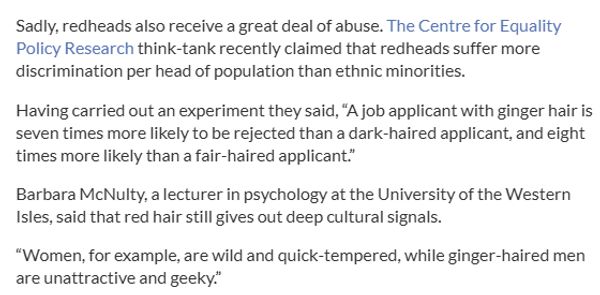
A separate study cited by the Centre for Equality Policy Research similarly found evidence that red-haired applicants faced significantly greater discrimination in hiring. According to the reported findings, applicants with ginger hair were substantially more likely to be rejected than otherwise comparable applicants with darker or fair hair. Researchers also noted that persistent cultural stereotypes surrounding red hair may continue to influence workplace perceptions and employment decisions.
( Read More )
World's Largest Sperm Bank Rejects Redheaded Donors
"When does consumer preference become discrimination?"
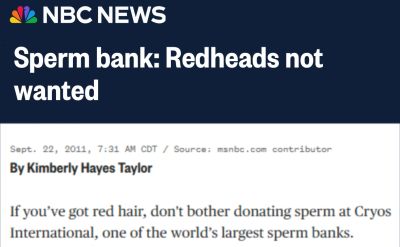
In 2011, Danish sperm bank Cryos International, then one of the world's largest sperm banks, announced it would no longer accept sperm donations from most red-haired men. The company stated that it already had more red-haired donor sperm than demand justified and that customers overwhelmingly preferred donors with dark hair and brown eyes. Cryos director Ole Schou suggested that most recipients would not intentionally choose a red-haired donor unless they specifically wanted a child with red hair. ( Read More )
NYPD Reminds Officers Not to Discriminate Against Redheads
"Why would a police department need to issue this reminder?"
In 2013, the New York Police Department reminded supervisors and officers that discrimination and harassment based on hair color—including red hair—were prohibited under department policy. The guidance came after complaints that some red-haired officers had experienced ridicule and derogatory comments in the workplace.
According to reporting, some officers described years of teasing and bullying over their hair color. One retired officer told the New York Post that he had been mocked throughout his childhood for having red hair and said the abuse continued into adulthood. The article also noted that public figures, including model Lily Cole, had spoken out about the widespread acceptance of bullying directed at redheads. ( Read More )

A Global Survey of Redhead Discrimination (2014)
"How common is discrimination against redheads?"
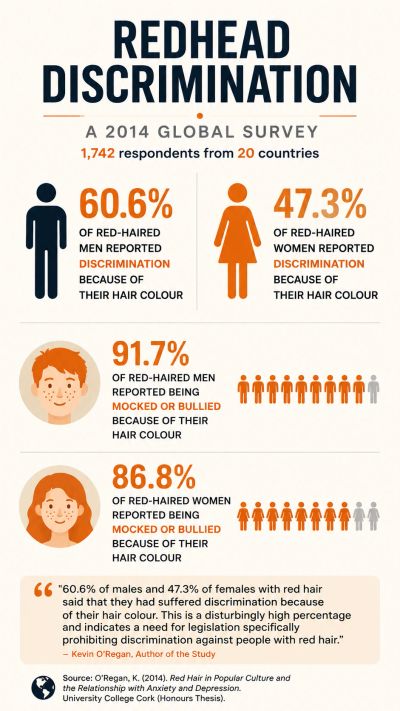
A 2014 honours thesis from University College Cork surveyed 1,742 people from 20 countries to examine the experiences of individuals with naturally red hair. Among respondents with red hair, 60.6% of men and 47.3% of women reported experiencing discrimination because of their hair color. The study also found that 91.7% of red-haired men and 86.8% of red-haired women said they had experienced bullying or mockery because of their hair color.
Reflecting on the findings, the author wrote:
"60.6% of males and 47.3% of females with red hair said that they had suffered discrimination because of their hair colour. This is a disturbingly high percentage and indicates a need for legislation specifically prohibiting discrimination against people with red hair."
Although the research was conducted as an undergraduate honors thesis rather than a peer-reviewed journal article, it remains one of the largest dedicated surveys of red-haired people's experiences across multiple countries. Its findings suggest that discrimination and bullying based on natural red hair are reported by a substantial proportion of respondents.
A 17th-Century Condemnation of Anti-Redhead Prejudice
"You don't write an entire chapter fighting a prejudice that doesn't exist."
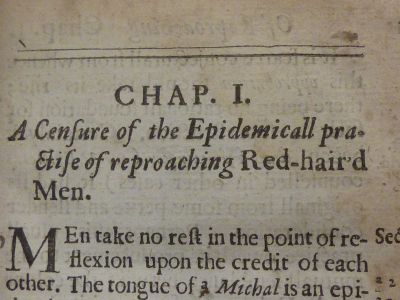
In 1659, English writer Obadiah Walker devoted the opening chapter of his book Periamma Epidemion, or, Vulgar Errours in Practice Censured to defending red-haired people from prejudice. The chapter, titled "A Censure of the Epidemicall Practise of Reproaching Red-Hair'd Men," argues that ridicule of redheads was a widespread but irrational social custom.
Walker wrote:
"Each man disparageth his fellow-creature... My present instance shall be in a common yet causeless calumniation: viz. the vilifying of red-hair'd men, the putting of disesteem upon persons, merely because of the native colour of the excrement of the head."
He went on to argue that mocking people for their natural red hair had "no rational foundation," defending red hair as neither a mark of evil nor a defect, but simply another natural human characteristic. More than 350 years later, Walker's criticism of prejudice remains strikingly relevant.
Source: Cardiff University Special Collections & Archives, A 17th century defence of red hair.